

Great Barrier Reef Essential Packing List

What should you take to the Great Barrier Reef? I was wondering the same thing before I took a Great Barrier Reef tour for the first time!
For many people, going to the Great Barrier Reef to snorkel or scuba dive is a once-in-a-lifetime experience.
Of course, if you’ve never been to the Great Barrier Reef, you’re not quite sure what to expect. And, you don’t want to forget anything you’ll need once you get there.
The Great Barrier Reef is a UNESCO World Heritage Site and one of the seven wonders of the natural world. It’s the world’s largest coral reef system, and the more than 600 types of hard corals provide an intricate home for marine life.

The Great Barrier Reef is home to more than 1600 species of fish, more than 100 species of jellyfish, more than 130 varieties of sharks and rays, and more than 30 species of whales and dolphins.
Depending on when and where you go, you might see manta rays, sea turtles, minke whales, or reef sharks, as well as any number of tropical fish.
You can choose from a variety of Great Barrier Reef trips, depending on if you want to scuba dive, take a snorkel tour, or see the reef above on a helicopter tour.
To get to the outer reef, most tours depart from Cairns, but tours also leave from Port Douglas or other towns along the North Queensland coast. Most one day reef tours take visitors by boat to a moored pontoon stationed on the reef.
Regardless of what you want to do once you’re on the Great Barrier Reef and where your point of departure is, you’ll want to be sure you have everything you need for a day at the Great Barrier Reef–or everything you need for a few days and nights at the Great Barrier Reef!
Here’s a comprehensive list of what you should bring to the Great Barrier Reef and what you can leave behind.

What’s included in your Great Barrier Reef tour?
First, before you start packing anything, find out what’s provided by your tour operator.
This information should be provided on the tour website. If you aren’t sure, just email the contact and ask for clarification.
Your tour may provide:
Stinger suits
Stinger suits protect you from jellyfish on the reef.
Marine stingers can be present year-round in tropical Queensland. The risk of getting stung by these dangerous jellyfish is higher during marine stinger season, typically November through May.
Also, stinger suits protect you from the sun.
Wetsuits
If you’re scuba diving, you’ll need a wetsuit at any time of the year. Even for snorkeling, wetsuits are essential in the cooler months (March through October) at the Great Barrier Reef.
Snorkeling gear
If snorkeling is advertised as part of your tour, you can expect all snorkeling gear to be included.
Diving equipment
Most dive operators provide diving gear. Whether you’re planning your first dive or are already a certified diver, your tour operator should provide everything you need.
Prescription masks
If you wear glasses, it’s so much easier to use a prescription mask. Lots of tours have these available for rent.
Check with your tour operator in advance to confirm that all of these things are included in your tour.
Some tours provide these items with no additional charge, as an inclusive part of the tour price. Other tour operators will charge extra fees to rent various pieces of equipment.

What to bring to the Great Barrier Reef
Here are all the things that you will want to bring with you to the Great Barrier Reef.
Sun protection at the Great Barrier Reef
Let’s start the list of what to bring to the Great Barrier Reef with sun protection. The Australian sun can be very intense, and that’s particularly true on the water.
Reef-safe sunscreen
It’s really important to use reef-safe sunscreen that uses physical UVA and UVB filters, like zinc oxide and titanium dioxide.
Avoid products with oxybenzone or octinoxate, and avoid sunscreens with nanoparticles.
Apply your sunblock at least 30 minutes before you get in the water.


Lip balm
Choose a lip balm with sunscreen so your lips don’t burn or get chapped from the wind and salt water.


Long-sleeve clothing
Wearing a shirt with SPF will protect you from the sun just as well as sunscreen. Throw a rashguard or a shirt with built in sun protection over your swimsuit to protect your skin when you’re not in the water.
Sunglasses
The sun glare from the water is bright! Polarized lenses are best, but bring whatever you have.
Hat
A broad-brimmed hat should be part of your everyday sun protection in Australia, no matter where you are. A had with a broad brim is best, so it will protect your neck. If you have a hat that can be tightened so it won’t blow off, that would be a good choice for a reef tour.

What to wear at the Great Barrier Reef?
Swimsuit
It’s one of the easiest things to forget! Even if you plan to wear a wetsuit or stinger suit, you’ll wear a bathing suit underneath.
It’s easiest to wear this on the boat, under clothes or a cover-up, so you don’t have to spend time changing once you get to the snorkel or dive site.
Flipflops or water shoes
Handy for walking around on wet decks on pontoon platforms, and imperative if you go to a Great Barrier Reef island with rough corals in the sand. Flipflops are great, but also look at Tevas or Chacos for more support and stability.
Dry Clothes
Bring an extra set of dry clothes to change into for the ride back to the mainland.
Bring something comfortable and seasonally appropriate. You might want a sundress or t-shirt and shorts in the summer, but a sweater and pants in the winter.
jacket or windbreaker
Having a light jacket with you will help you stay warm if the boat is windy or you’re cool from the water.

What’s the best Camera to take to the Great Barrier Reef?
On most larger tours, a photographer will be on board, snapping pictures of everyone. You’ll be able to buy photos at the end of your trip. On smaller boats, you’ll have to take your own photos if you want souvenirs of the day.
If you want to capture memories of your time at the Great Barrier Reef yourself, bring a camera.
GoPro Hero 11
The best underwater camera is a GoPro. If want higher quality photos that capture the natural beauty of the reef, you’ll want to to take a GoPro with you to the reef.
This GoPro camera will allow you to capture high-resolution photos and video to document your time at the Great Barrier Reef. It has stabilization so all your footage is smooth.
It’s also possible to rent a GoPro from a camera store in Cairns before you head out to the reef. You should reserve one well in advance of your dive or snorkel trip.


AKASO Underwater Camera
The AKASO action camera is waterproof to 98 feet, and comes with a waterproof case. It’s easy to use and will take great pictures of the coral reefs and fish you encounter at the Great Barrier Reef.


Waterproof phone case
If you want to use your smartphone for photos, bring a waterproof phone case. Some tour boats have these for sale, but they’ll be more expensive to buy on the boat.


Batteries/battery pack
Bring extra batteries, chargers, and a portable battery, depending on what kind of camera you’re using.
Extra SD Cards
Don’t forget the storage card for your camera–and bring extras!
Check your camera to see which kind of SD cards it requires. Before you head out to the Great Barrier Reef, format the cards with your computer.
Floating attachment
A camera float is essential, so you don’t lose your camera to the depths of the reef.


What to bring to minimize seasickness at the Great Barrier Reef?
Many people suffer from motion sickness when riding in a boat to the Great Barrier Reef. But there are several ways you can avoid seasickness on a tour of the Great Barrier Reef.
Of course, talk with your doctor before taking any medications.
On your boat ride to the Great Barrier Reef, you should bring:
Seasickness medication
If you forget to bring Dramamine from the US, you can stop in a local pharmacy to pick up motion sickness tablets.
Pressure bands
Some people find that wearing a motion sickness bracelet, like Sea-Bands, helps prevent seasickness.
mints or gum
Mints, ginger candies, or chewing gum help some people stave off motion sickness.

Practical things to bring to the Great Barrier Reef
Here are some practical things you’ll need at the Great Barrier Reef:
Cash
Sometimes on reef tours, there are connectivity issues that make it difficult to pay by credit card. It’s always best to have plenty of Australian dollars on hand to cover extra costs for add-on tours, equipment rental, or snacks.
Credit Cards
Obviously, as long as the boat has good connectivity, credit cards are very easy to use. So it’s a good idea to bring at least one.
Dive License
If you are a certified scuba diver and you want to dive at the Great Barrier Reef, you must provide your diving certification.
Photo ID
Along with your dive license, you will need to bring your photo ID for proof of identity.
Medical Clearance
Anyone with medical conditions who wants to participate in water activities, particularly diving, will have to provide proof that their doctor has given them medical clearance to dive.
It’s best to have a medical certificate from your doctor on hand, just in case you need to provide it.
Water bottle
Bring a refillable water bottle with you. The boat will have water available for you, but having your own water bottle makes it easier to stay hydrated.
Towel
You can bring a big beach towel, a thin Turkish towel, or a small microfiber travel towel. It really just depends on which you prefer.

Food to bring on a Great Barrier Reef Tour
Special Diet
If you have any special dietary needs, you probably need to bring food with you to the Great Barrier Reef.
Most tours include a buffet lunch as part of their tour package. Check with the tour company in advance to find out if there will be something in the meal that you can eat.
Larger tour companies have less ability to customize their menus to individual guests’ needs. If you’ve chosen a smaller tour, you might have better luck asking for dietary accommodations. Contact the tour company well before your tour date for more information.
Snacks
If you like, you can bring snacks on the Great Barrier Reef tour. Most tours include at least one meal. Some include a morning or afternoon tea. Others either include snacks or have them available for purchase.
So, you might not need to bring snacks, but you can. Again, confirm with your tour operator in advance.
What to bring on an overnight Great Barrier Reef tour?
If you’re going for an overnight stay at the Great Barrier Reef for a multi-day snorkel or dive excursion, you’ll need to bring some extra things with you.
Overnight tours on the Great Barrier Reef
Pajamas
If you’re staying overnight, you’ll need your pjs.
Toiletries
Toothbrush, toothpaste, etc. You know what you need!
Medications
Any prescriptions or over the counter medicines that you take every day.
Evening wear
Nothing fancy! Just some warm clothes you can wear on deck. After the sun goes down, it’s much cooler on the water.
Chargers
Bring your phone and camera chargers, as well as extra batteries.
Tote Bag
Overnight Great Barrier Reef tours don’t allow guests to bring zippered bags with them. You must pack your belongings in a zipless bag.
There’s a simple way around this. Just bring a shopping tote or a souvenir canvas tote bag. If you forget to bring one on your trip, you can buy one at any grocery store or tourist shop.


Going to the Great Barrier Reef
If you’re wondering how to pack for your trip to the Great Barrier Reef, it’s good to know what you’re packing for!
Travel by Air
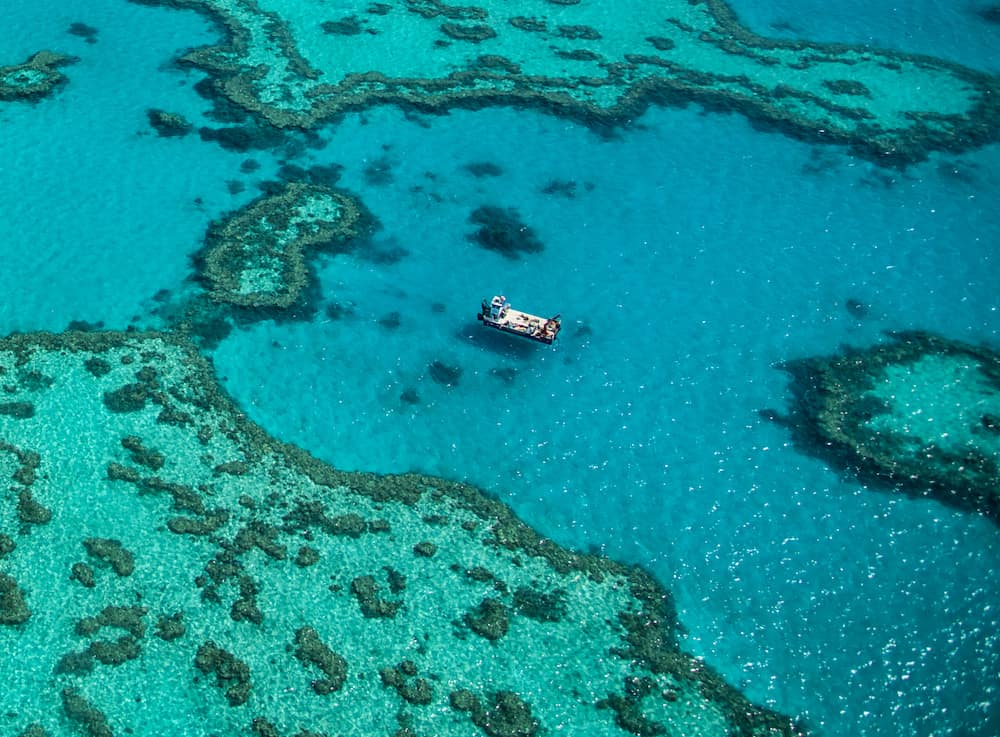
You can take a scenic helicopter flight to the outer Great Barrier Reef, or you can also fly in a small plane. Either way, you’ll have an amazing view of the Great Barrier Reef!
For anyone who gets seasick, a scenic flight is the best way to experience the Great Barrier Reef.
Travel by Boat
Most visitors reach the Great Barrier Reef via a short boat trip.
Generally, on bigger boats, the trip lasts about 90 minutes to two hours. (If that sounds like a very long trip to you, read up on how to avoid getting seasick when you go to the Great Barrier Reef.)
Best Great Barrier Reef Tour
Here are some of the best Great Barrier Reef Tours:
Best Day Trip by Air

⭐️ Rated: 5 out of 5 stars (51 reviews) | ⏱️ Length: 9 hours | 🐠 Book Now
Take a scenic flight from Cairns over the Great Barrier Reef and the Daintree Rainforest, then spend the day at Lizard Island.
You’ll have time for snorkeling, taking a hike, and relaxing on the beach. The tour includes a guide, lunch, and snacks, as well as the round-trip flight.
Best Overnight Great Barrier Reef Tour

⭐️ Rated: 5 out of 5 stars (227 reviews) | ⏱️ Length: 2 Days | 🐠 Book Now
Go on an overnight sailing trip to remote reef sites on the Great Barrier Reef. This two-night excursion is limited to 12 people. Appropriate for certified and beginner divers.
Best Day Trip to the Great Barrier Reef

⭐️ Rated: 5 out of 5 stars (22 reviews) | ⏱️ Length: 8.5 hours | 🐠 Book Now
Sail to the Great Barrier Reef in luxury on a superyacht cruise. This tour is limited to 8 guests, so you’ll be able to ask lots of questions of the on-board marine biologist. You’ll have 5 hours at sea to snorkel or take in the view.
Best time to go to the Great Barrier Reef
Peak season
Many people think that between June and October is the best time to visit the Great Barrier Reef. This is winter and early spring in Australia.
You’re less likely to encounter rainfall so the water is clearer and better for diving. Temperatures will be in the low 60s to mid 80s (F).
If you go to the Great Barrier Reef in June to October, be sure to pack some warm layers. If you’re staying overnight on the reef to experience a night dive, expect the evenings to be fairly cool.
Between July and September, you can observe humpback whales migrating.
In June and July, Australian schools are on holiday, so expect more crowds at the reef then.
Off Season
Low season for the Great Barrier Reef is between November and May, when water temperatures are higher. This is “stinger season,” when deadly box and Irukandji jellyfish can be found in the waters of the Great Barrier Reef. It’s also the wet season, so the water visibility is poorer. This can be quite dangerous for divers in deep water.
If you go to the Great Barrier Reef in November to May, daytime temperatures will be higher, but you’ll need to be extra careful about wearing a stinger suit to protect yourself from the jellyfish. You’ll also have to pay attention to the weather reports, as it’s possible that frequent rains will cause flooding.
Around May, you can watch Minke whales migrating off the Queensland coast.
Overall, the very best times to visit the Great Barrier Reef would be late May/early June and September/October, when you can get the best weather, avoid holiday-makers, escape the stingers, and have a chance of spotting migrating whales!
Final thoughts on what to bring to the Great Barrier Reef
Planning a trip to the Great Barrier Reef can feel a bit overwhelming, but it’s absolutely worth it.
There’s nothing like exploring one of the natural wonders of the world. As climate change threatens the Great Barrier Reef and individual reef systems experience coral bleaching, now is the perfect time to plan a visit to the Great Barrier Reef.
I hope these tips on what to take with you to the GBR help you plan your trip and have a wonderful experience at the Great Barrier Reef! Visiting the Great Barrier Reef was one of our favorite parts of our family sabbatical in Australia, and I know you’ll love your trip there too!


