

18 Best Places to Visit In Baden-Württemberg: What to do & Eat

Are you planning a trip to Baden-Württemberg and wondering what you should do there?
This blog post is about the best things to do in Baden-Württemberg, plus what foods to try while you’re there!
Nestled in the southwest corner of Germany, Baden-Württemberg is home to stunning natural beauty, thermal spas, fairytale castles, and delicious local specialties.
Baden-Württemberg shares international borders with France to the west and Switzerland to the south. Domestically, it is bordered by the German states of Rhineland-Palatinate to the northwest, Hesse to the north, and Bavaria to the east and northeast. The state capital is Stuttgart, which is also its largest city.
Baden-Württemberg is known for its economic strength, particularly in the automotive and mechanical engineering industries.
The region is also famous for its high quality of life, picturesque towns, spectacular scenery, and historical sites, including numerous castles and medieval churches.
Much of the region of Baden-Wurttemberg is part of the Swabian cultural, historic, and linguistic region of Germany.
Swabia isn’t a state, and its borders aren’t sharply defined. Swabia is mostly in Baden-Wurttemberg, but also in Bavaria. Swabian culture has a unique German dialect, specific foods, and pride.
Baden-Württemberg has a rich cultural heritage with deep-rooted traditions, including the famous Black Forest with its folklore and the celebrated Swabian cuisine.
You’ll be captivated by this lovely region of Germany, so here’s the best list of places to see and things to do in Baden-Wurttemberg, Germany!
Best Places To See & Things To Do In Baden-Württemberg, Germany
Baden-Württemberg, a picturesque region of Germany, offers a variety of popular attractions that are exactly what you’re hoping to find when you visit Germany. Some of the area’s best destinations include:

1. Stuttgart
The city of Stuttgart is the regional capital of Baden-Württemberg. Stuttgart is famous for its automotive history, housing both the Porsche and Mercedes-Benz museums.
It’s also known for its vibrant cultural scene, including art galleries, the Stuttgart ballet, and a bustling nightlife.
Stuttgart’s actual foundation goes back to around 950 AD when Duke Liudolf, Duke of Swabia, established a stud farm for warhorses. The city’s name reflects this origin: Stuttgart comes from the Old High German ‘Stuotgarten’, meaning ‘stud farm’.
During World War II, Stuttgart suffered significant damage due to Allied bombing but recovered in the post-war era, becoming a major cultural, economic, and industrial center.
Today, Stuttgart is one of Germany’s well-known large cities. The city’s economy has strong ties to the high-tech industry and the automotive sector, with major corporations like Porsche, Bosch, and Mercedes-Benz Group headquartered there. The city is also an important financial center and a significant transport junction.
Top things to do in Stuttgart:
- Hang out in the city centre. Head to the Palace Square, where you’re likely to find a festival or special event. Walk over to Königstraße (King Street) to shop. If you’re not sure where to start, take a private walking tour of Stuttgart to get acclimated.
- Stuttgart has a vibrant cultural scene with numerous theaters, museums, and historical sites, including
- the Museum of Illusions
- the contemporary art museum, Kunstmuseum Stuttgart
- the Wine Museum
- Visit the Mercedes-Benz Museum and Porsche Museum.
- Eat well! Check out the Stuttgart Market Hall or take a walking tour devoted to Swabian specialties!
- If you visit in the fall, go to Cannstatter Wasen Volksfest, an annual three week autumn festival (Many consider the event to be the second largest beer festival in the world, second only to Munich’s Oktoberfest).
- If you visit in December, don’t miss the Stuttgart Christmas Market!

2. Ludwigsburg
Located just north of Stuttgart, Ludwigsburg is renowned for its Baroque Ludwigsburg Palace, sometimes called “the Versailles of Swabia,” and its famous annual Pumpkin Festival.
Duke Eberhard Ludwig of Württemberg founded Ludwigsburg in the early 18th century. Initially, he planned it as a hunting lodge and country retreat, but it quickly grew into a town.
The Ludwigsburg Palace is one of the largest Baroque buildings in Europe, famous for its architecture, gardens, and interior.
Things to do in Ludwigsburg:
- Tour the opulent Ludwigsburg Palace (Residenzschloss Ludwigsburg).
- The palace gardens are a must-see, especially during the spring and summer when they are in full bloom.
- Take a walking tour of Ludwigsburg about the history of the city, or one with a special focus, like the city’s scary history or the madness tour.
- Visit Favorite Park and Hunting Lodge (Schloss Favorite) for a look into the region’s hunting history and nature.
- Historic buildings surround the vibrant market square, which is a great place for shopping and dining..
- The Ludwigsburg Museum offers insights into the city’s history and culture, and the Fashion Museum (Modemuseum) showcases historical fashion trends.
- Ludwigsburg is famous for its Pumpkin Festival (Kürbisausstellung) in autumn, which is the largest of its kind in the world, and the Fairy-Tale Garden (Märchengarten), perfect for families with children.

3. Schwäbisch Hall
This historic town has beautifully preserved medieval architecture. Schwäbisch Hall features cobblestone streets, half-timbered houses, and a striking town square where the famous St. Michael’s Church is located.
The name of the town doesn’t come from an actual building, like a Town Hall, but from a West Germanic word that means “to dry something by heating it.” Perhaps the town’s name is due to the town’s salt production.
Schwabisch Hall, while a small town, has some really great museums, a gorgeous marketplace, and fantastic Swabian food. You can easily spend a whole day here.
Things to do in Schwäbisch Hall:
- Wander through Schwäbisch Hall Altstadt (Old Town).
- At the Hallisch-Frankisches Museum, exhibits tell the history of Schwabish Hall, including the town’s significance in salt production. Exhibits go from prehistoric times through post-WWII.
- See Johanniterkirche, where you’ll find a superb collection of 15th and 16th century paintings by German Masters.
- St Michael is a beautiful church dating back to 1156, and you can climb the bell tower. It hosts an incredible Christmas market.
- Kunsthalle Würth Museum is a well-curated modern art museum with free entrance!
- At Hohelloher Freilandmuseum, you’ll feel like you’ve stepped back in time at this open air museum.
- A visit to Grosscomburg Monastery requires a steep, uphill climb, but the buildings and the view are worth it.

4. Heidelberg
Often described as Germany’s most beautiful city, Heidelberg is famous for being one of the most romantic cities in Baden-Wurttemburg. Heidelberg’s attractions include a world-famous castle, baroque mansions, a charming old town, lush forests, and a Bohemian atmosphere.
Heidelberg has a rich and long history, dating back to Roman and Celtic times. The city, first mentioned in documents in 1196, was planned and built alongside the Heidelberg Castle in the 13th century.
Heidelberg’s romantic cityscape, including the famous Heidelberger Schloss, or Heidelberg palace, which is now in ruins, attracts many visitors. However, the castle ruins are worth seeing.
You can take a funicular railway from Kornmarkt in the old town to Molkenkur, then continue with one of the oldest electric funicular railways to the Königstuhl, the town’s highest point at more than 550 metres above sea level.
What to do in Heidelberg:
- Take a walking tour to immerse yourself in Heidelberg’s history, like this comprehensive walking tour of Heidelberg.
- Explore the old town’s charming Baroque streets, with a mix of historical buildings, shops, and cafes.
- Heidelberg Castle is must-see landmark offering a glimpse into the city’s past and stunning views of the surrounding area. The remains of the castle ruins are still impressive!
- At the castle, don’t miss the German Apothecary Museum. This fascinating pharmacy museum details the history of remedies of all sorts.
- Philosophers’ Walk is a scenic path offering beautiful views of Heidelberg and the Neckar River, particularly popular for its romantic and picturesque setting.
- Check out Heidelberg University. As Germany’s oldest university, founded in 1386, it offers rich architectural and academic history.
- The Neckar River provides a beautiful backdrop to the city. Glide past the Old Bridge and Heidelberg Castle, and through the Neckar Valley, in an antique wooden sloop or in a kayak, or relax as you enjoy a breakfast buffet on a river cruise.
- Heidelberg has many museums for art, history, and science, including the Egyptian Museum, the Carl Bosch Museum, and the Body Worlds Museum.

5. Schwetzingen
Famous for Schwetzingen Palace and its exquisite gardens and follies, visitors who love baroque architecture and landscaped parks should be sure to see Schwetzingen.
The palace gardens blend of French formal and English landscape gardening styles and feature numerous sculptures, fountains, and an impressive orangery.
In May, the town hosts a white asparagus festival.
Things to do in Schwetzingen:
- Take a guided tour of Schwetzingen Palace to see the beautiful Baroque-style interiors.
- Tour Schwetzingen Gardens and enjoy the follies, including a fanciful mosque. Enjoy a coffee and cake in the on-site cafe.
- Schwetzingen has a fun collection of public statues. Look for the Schwetzinger Spargelfrau (Asparagus women) and Gluecksswein (the Lucky Pig).

6. Karlsruhe
The City of Karlsruhe, founded in 1715 by Margrave Charles III William of Baden-Durlach, is a relatively young city by European standards. Its distinctive fan-shaped layout, with streets radiating outward from the central Karlsruhe Palace, was a revolutionary urban design for its time.
The city quickly became a center for the arts and sciences, influencing Enlightenment thought. During the 19th century, Karlsruhe emerged as a hub for technological innovation, especially in engineering.
What to do in Karlsruhe:
- Karlsruhe Palace (Schloss Karlsruhe) at the city’s center houses the Baden State Museum, showcasing regional history and art.
- ZKM | Center for Art and Media is a unique cultural institution combining art and technology. It features exhibitions, multimedia installations, and interactive art experiences.
- The State Art Gallery (Staatliche Kunsthalle) exhibits a wide range of artworks, including pieces from the 14th century to contemporary art.
- Karlsruhe Pyramid in the market square marks the tomb of the city’s founder, Margrave Karl Wilhelm of Baden-Durlach. Take a walking tour of Karlsruhe, to explore all the sites.
- Karlsruhe Botanical Gardens offer a tranquil escape with beautifully landscaped grounds and a range of plant species.
- Natural History Museum (Naturkundemuseum) showcases regional flora and fauna, including a large collection of fossils.
- The historic district of Durlach offers charming streets, quaint shops, and a medieval atmosphere. Visitors can hike or take a funicular from Durlach to the top of the Turmberg for panoramic views of Karlsruhe and the Rhine Valley.
- The Stadtgarten, a large park in the city center, is a lovely spot for relaxation and includes a small zoo.

7. Baden-Baden
A historic spa town located on the edge of the Black Forest, Baden-Baden boasts thermal baths, luxurious spa facilities, casinos, and posh shops.
Baden-Baden has a rich history dating back to Roman times when it was known as Aquae and Aurelia Aquensis. The Romans, recognizing the therapeutic value of the area’s hot springs, established bath facilities here.
These baths were not just for healing but also served as social and relaxation centers. People used Baden-Baden’s thermal waters for medicinal purposes throughout the Middle Ages and beyond.
In the 19th century, Baden-Baden emerged as a sophisticated international gaming resort, particularly famous for its Casino housed in the Kurhaus.
European elite, including cultural and ruling figures, frequented Baden-Baden, and the city became known as the “Summer Capital of Europe.”
Today, Baden-Baden is celebrated for its luxurious spa facilities and architecture that exemplify the popularity of spa towns in Europe from the 18th to the 20th centuries.
Best Things to do in Baden-Baden:
- Start your visit with a walking tour to get the inside scoop on Baden-Baden’s history.
- Indulge in the town’s famous spas.
- Stroll the beautiful Lichtentaler Allee, a park full of flowers, fountains, and sculptures, perfect for wandering through on a beautiful day.
- Visit the spa garden outside the Kurhaus. Wander beneath historic chestnut trees, enjoy the massive flowerbeds, and, if you time it right, enjoy one of the many festivals or markets held there throughout the year.
- Even if you’re not a gambler, dress up and go marvel at the Casino’s grandeur.
- Museum Frieder Burda features strikingly innovative architectural design and an impressive contemporary art collection, complemented by changing temporary exhibitions.
- In the central Marktplatz, you’ll find Stiftskirche, a marvelous pink church. Enjoy the combination of Roman, Gothic, and Baroque architecture and the lovely stained glass windows.

8. Europa Park
For families, with children who have had enough museums and castles, there’s Europa-Park.
Located near the city of Rust, Europa-Park Resort is one of the largest theme park in Germany and the second-largest in Europe (with Disneyland Paris taking first place).
Europa Park has a theme park with roller coasters. as well as a huge water park. You’ll also find six themed hotels, special events, and multiple restaurants.
This isn’t a German experience per se, but it’s certainly one of Baden-Wurttemberg’s most popular destinations.
Things to do at Europa Park:
- Explore the more than 100 attractions and shows.
- Dare to ride the theme park’s 13 roller coasters.
- Explore the water park.
- Dine at some of the 25 restaurants and bars.
- Relax at the sauna or spa.

9. The Black Forest
The Black Forest, known in German as the Schwarzwald, is a large forested mountain range in south-west Germany. It is famous for its dense evergreen forests and picturesque villages, as well as the Brothers Grimm fairy tales.
You’ll see traditional crafts, including the famous cuckoo clocks, Bollenhut hats, and wood carving.
Take the Black Forest High Road (Schwarzwaldhochstraße) from Baden-Baden to Freundenstadt for stunning views of the Black Forest and the most incredible views of the valleys below.
There are plenty of places to stop along the way, but you shouldn’t miss the Black Forest Open-Air Museum (Vogtsbauernhof).
You’ll find an outdoors museum set up like a village, with old buildings rescued from farms in the region. You’ll see old furniture, timbered houses, farm animals, and exhibits about the history of the area.
In the Black Forest National Park, you’ll find many hiking trails, including the famous Westweg Trail. The Triberg Waterfalls, sometimes called the highest waterfalls in Germany, are also a popular hiking destination.
In winter, the Black Forest becomes a hub for skiing, snowboarding, and other winter sports, with Feldberg being the highest mountain in Baden-Wurttemberg and a popular ski resort.
The Black Forest hosts various traditional festivals and events throughout the year, providing visitors with an authentic experience of local customs and traditions.
Things to do in the Black Forest:
- Explore traditional villages with half-timbered houses, such as Triberg, Gengenbach, and Schiltach.
- Depending on the season, you can hike, ski, or participate in other outdoor activities.
- In the heart of the Black Forest, the Titisee is a beautiful lake with crystal-clear waters and serene natural surroundings. It’s a popular destination for boating, swimming, and hiking. The adjacent town of Titisee-Neustadt is charming, with its traditional Black Forest houses and shops selling cuckoo clocks and local crafts.
- The Black Forest Road (Schwarzwaldhochstraße) winds through the Black Forest, offering breathtaking views and access to numerous attractions, hiking trails, and picturesque villages. It’s one of the oldest and most well-known tourist routes in Germany.
- Open-Air Museum Vogtsbauernhof, located in Gutach, provides an insight into the rural life of the Black Forest region. It features original farmhouses from different parts of the Black Forest, from the 16th to the 19th century, as well as interactive displays about traditional crafts, farming practices, and the everyday life of the Black Forest’s past.
- Take a day tour to the Black Forest to get the full experience without having to navigate the mountainous roads!
- Take incredible photographs of nature around every bend in the Black Forest. Use these fantastic nature quotes and captions and nature hashtags when you post your photos on Instagram

10. Freiburg im Breisgau
As Germany’s sunniest city, Freiburg is a charming university town near the French Border. Freiburg is known for its Gothic sandstone cathedral, historic monuments, and the beautiful views from Schlossberg.
The fascinating history of Freiburg im Breisgau stretches back over 900 years.
The University of Freiburg, one of the oldest universities in Germany, was founded here in 1457. Freiburg also experienced significant plague epidemics from the 15th century to the 17th century and was involved in witch-hunting during this time.
The city’s two surviving medieval gates, Martin’s Gate and Swabian Gate, are notable landmarks. Martin’s Gate has with a plaque commemorating the witch hunts, while the Swabian Gate houses a Tin Figure Cabinet, depicting events from the Baden Revolution and the witch hunts.
For visitors, Freiburg offers a rich blend of history, culture, and modernity. The historic Old Town, with its medieval Swabian Gate, intricate building facades, and the famous Freiburg Cathedral, contrasts sharply with the city’s modern architecture.
Things to do in Freiburg im Breisgau:
- Take a guided walking tour of the historic old town. Freiburg has a lot of history, and having a guided tour will add so much meaning to your visit.
- Try not to fall in the Bächle! Freiburg’s Bächle, small water channels flowing through the streets of the Old Town, date back to the Middle Ages. Legend says that if you step in a backhoe, you’ll have to marry a Freiburger!
- Explore Munsterplatz, the lovely cobblestone square at the heart of Freiburg.
- Tour the Freiburger Munster, Freiburg’s most iconic landmark. This stunning cathedral, built from red sandstone, took more than 300 years to complete
- Take the Scholossbergbahn funicular up Schlossberg Hill to see the castle ruins and climb the Schlossbergturm, the observation tower.
- End your day with a pub crawl to explore the best of Freiburg nightlife!

11. Konstanz and Bodensee
The city of Konstanz (Constance) is located at the western end of Bodensee (Lake Constance).
Lake Constance, known as Bodensee in German, a large freshwater lake situated in the northern foothills of the Alps, borders three different countries: Germany, Austria, and Switzerland.
It is one of the largest lakes in Central Europe and a popular destination for tourists and locals alike. The lake has three bodies of water: the Obersee (upper lake), the Untersee (lower lake), and a connecting stretch of the Rhine, called the Seerhein.
Konstanz, located just across the border from Switzerland, has a charming, well-preserved medieval Altstadt (old town) and a beautiful harbor. Konstanz is one of the most beautiful places in Baden-Wurttemberg to visit, especially in the summer.
Things to do in Konstanz and Bodensee:
- A stroll through the historic Old Town is a must, to see medieval architecture, quaint shops, and cafes. Take a tour with a medieval night watchman to get the full story.
- Konstanz Minster (Konstanzer Münster) offers stunning views of the city and Lake Constance from its tower.
- As Germany’s largest lake, Lake Constance (Bodensee) offers opportunities for boat trips, water sports, and lakeside relaxation.
- The Island of Mainau, known for its beautiful gardens, butterfly house, and Mediterranean flair, is a short boat trip from Konstanz.
- The Rosgarten Museum showcases the city’s history, while the Sea Life Konstanz aquarium is great for families.
- The New Palace is pretty, but its best feature might be its view of Lake Konstanz and the garden.
- For relaxation, the Bodensee-Therme Konstanz offers thermal baths with views of the lake.
- The region offers excellent cycling and hiking paths, including the popular Lake Constance Cycle Path, which encircles the entire lake.
- The Lake Constance region hosts various festivals and events throughout the year, including the Bregenz Festival, known for its grand open-air opera stage on the lake.
- Take a wine tour of the region and visit three wineries.

12. Ulm
The area around Ulm has been settled since prehistoric times, but Ulm itself was first mentioned in recorded history around the 850s AD.
In the Middle Ages, Ulm became an important center of trade and commerce due to its location on the Danube River.
In the 14th century, construction of the Ulm Minster began. The Minster, a prominent symbol of the city, has the tallest church steeple in the world.
Albert Einstein was born in Ulm in 1879.
Today, the city offers a picturesque old Fisherman’s Quarter with cobbled lanes and traditional restaurants. Ulm blends historical sites and modern industries, particularly in the science and technology sectors.
Things to do in Ulm:
- Tour the Ulm Minster (Ulmer Münster). This Gothic church features the world’s tallest steeple and offers panoramic views of the city and surrounding area from its top.
- Fishermen’s Quarter (Fischerviertel), a picturesque area with cobblestone streets, half-timbered houses, and small bridges over the Blau river. It’s perfect for walking and exploring quaint shops and cafes. Take a walking tour to learn about the area’s history.
- The Albert Einstein Memorial is a tribute to the famous physicist who was born in Ulm.
- You can explore the parts of the medieval fortifications and Ulm city wall that still stand .
- The Ulm Museum houses art and archaeological collections, including works by modernist artists.
- The Museum of Bread Culture explores the history of bread and baking.
- The Danube River offers opportunities for scenic walks, cycling, or boat trips.
- The city also features striking modern architecture, such as the Stadthaus, a cultural meeting center, and the Ulm Library.
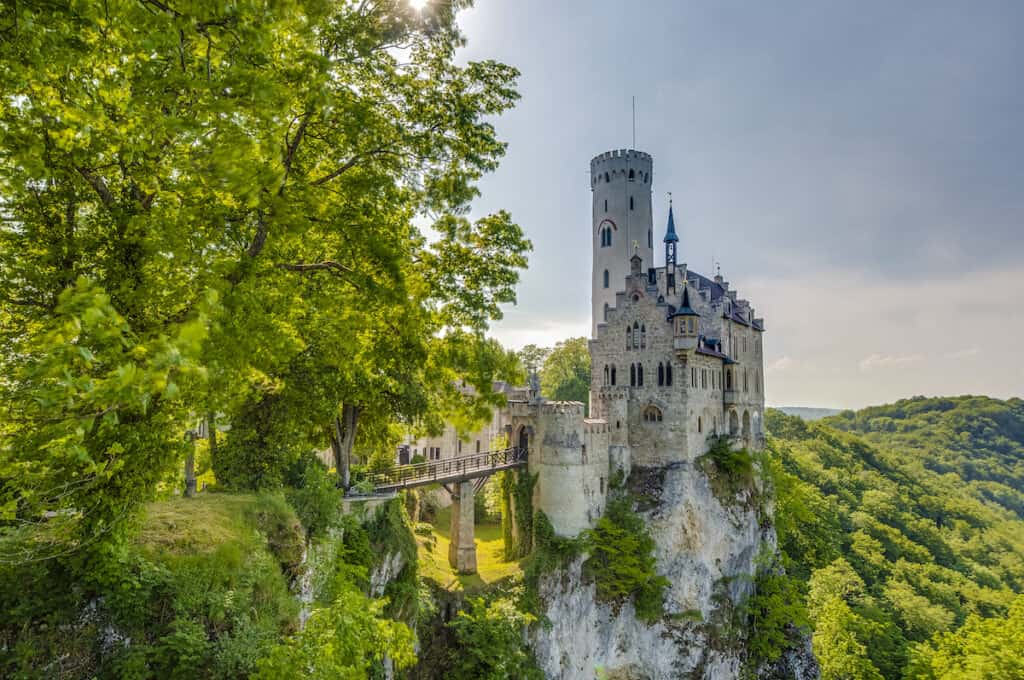
13. Visit Lichtenstein Castle (Schloss Lichtenstein) in Germany
Lichtenstein Castle, a quintessential symbol of romantic German architecture and medieval heritage, is located near the town of Honau on the Swabian Alb’s edge.
The current castle was built in the 19th century by Duke Wilhelm of Urach, inspired by Wilhelm Hauff’s novel “Lichtenstein.” However, its roots date back to a medieval fortress from the 12th century.
The castle is a stunning example of Gothic Revival architecture and is often referred to as the “Fairy tale castle of Württemberg” due to its picturesque and romantic appearance, perched dramatically on a cliff in the Swabian Alps.
What to do at Lichtenstein Castle:
- Take a guided tour to see the castle’s richly furnished rooms, art collections, and the armory.
- Explore the castle grounds and enjoy scenic views of the Echaz valley.
- Go hiking in the area around the castle.

14. Hohenzollern Castle
Burg Hohenzollern, a dramatic hilltop castle that was the ancestral seat of the imperial House of Hohenzollern, a family, which produced several Prussian kings and German emperors. This stunning castle offers impressive architecture and panoramic views.
What to do at Hohenzollern Castle:
- Take a guided tour of the castle’s interior, including the opulent rooms, the treasury, chapel, and various exhibits showcasing the history of the Hohenzollern family and the castle. Night tours are sometimes available.
- Enjoy the view from the top of Mount Hohenzollern, the castle offers breathtaking panoramic views of the surrounding Swabian countryside.
- There are hiking trails around the castle, providing a scenic and tranquil experience of the Swabian landscape. These trails offer different perspectives of the castle and the natural beauty of the area.
- Although the castle is more famous for its architecture and historical significance, the surrounding gardens and grounds are also worth exploring for their serene beauty.

14. Rottenburg am Neckar
Rottenburg am Neckar, situated on the banks of the Neckar River, has well-preserved medieval architecture and rich history.
The history of Rottenburg extends back to Roman times when it was a small settlement named “Sumelocenna”. Archaeologists have uncovered significant Roman artifacts and ruinsin the area.
Rottenburg grew in importance during the Middle Ages. It was officially recognized as a city in the 13th century and became a significant center for trade and commerce.
What to do in Rottenburg:
- The town’s old center is a picturesque area with cobblestone streets, half-timbered houses, and historic buildings.
- Rottenburg Cathedral (Dom St. Martin) is a landmark of the town.
- The Diocesan Museum (Diözesanmuseum) holds a significant collection of religious art and artifacts, reflecting the town’s ecclesiastical history.
- The Sumelocenna-Roman Museum (Römisches Museum) focuses on the town’s Roman past. The museum displays archaeological finds from the local area, including relics from the Roman settlement of Sumelocenna. Don’t miss this opportunity to see Roman toilets!

15. Tübingen
Tubingen is an ancient city with a vibrant, youthful vibe that is definitely worth visiting. The area around Tübingen was settled by the Celts and later by the Romans.
Tübingen grew significantly in the medieval period. The city’s castle, Schloss Hohentübingen, was constructed in the 11th century. Founded in 1477, the University of Tübingen is one of the oldest in Germany.
Industrialization didn’t change Tübingen, so much of its historic architecture remains. In the 20th century, it became known for its academic and liberal atmosphere.
Tubingen is absolutely charming and one of my favourite places in Baden-Wurttemberg.
What to do in Tübingen:
- The well-preserved medieval old town is characterized by narrow alleys, half-timbered houses, and historic buildings. A walk through the Altstadt is like stepping back in time.
- The University of Tübingen campus is worth exploring for its historic buildings and academic atmosphere. The university’s botanical garden is also a pleasant spot for a walk.
- Schloss Hohentübingen is a Renaissance castle overlooking the city, which hosts the Museum of Ancient Cultures, showcasing archaeological finds and historical artifacts.
- Stiftskirche in the city center offers panoramic views of Tübingen from its tower.
- Take a ride on a Stocherkahn, a traditional punting boat, on the Neckar River. The riverbanks are also perfect for leisurely walks.
- Holderlin Tower (Hölderlinturm), named after the poet Friedrich Hölderlin who spent the last years of his life there, is a literary museum and a symbol of Tübingen.

16. Reutlingen
Reutlingen has a rich history dating back over a thousand years.In the 19th century, Reutlingen evolved into an industrial center, particularly known for its textile industry.
The city was significantly damaged during World War II but was rebuilt in the following decades, blending modern infrastructure with historical preservation.
Reutlingen, with its mix of historical sites, cultural activities, and natural beauty, is ideal for those interested in exploring traditional German towns while enjoying the comforts and amenities of a modern city.
Things to do in Reutlingen:
- Recognized by the Guinness Book of World Records as the world’s narrowest street, Spreuerhofstraße is a unique sight in Reutlingen.
- The city’s historic center, with its medieval buildings, narrow alleyways, and traditional German architecture, offers a glimpse into its rich history. The Marienkirche, a Gothic church, is a notable landmark.
- The Heimatmuseum (Local History Museum) and the Naturkundemuseum (Natural History Museum) provide insights into the region’s history and natural environment.
- For a panoramic view of Reutlingen and the surrounding Swabian Alb, a hike or drive up to Achalm, a local mountain, is highly recommended.

17. Ritter Sport ChocoWorld
If you love chocolate, you’re no doubt familiar with the practical and delicious square Ritter Sport chocolate bars.
Ritter Sport ChocoWorld is located in Waldenbuch, close to Stuttgart. This famous German chocolate brand has a contemporary art museum, fantastic museum about the history of chocolate making, and an outlet store, so visitors can explore the world of Ritter Sport chocolates and stock up on bars to take home!
Waldenbuch is a bit out of the way, but there’s a bus from Stuttgart. If you love chocolate and appreciate unusual museums, Ritter Sport Chocoworld is one of the hidden gems of Baden-Wurttemberg.
Remember to bring an empty backpack to carry all the chocolate you’re going to buy!
What to do at Ritter Sport ChocoWorld:
- The Museum Ritter, showcases modern and contemporary art, with a focus on square artworks, resonating with the square shape of Ritter Sport chocolate bars.
- The Ritter Sport Chocolate Exhibit showcases the history of the chocolate production process and the Ritter Sport brand, highlighting Ritter Sport’s commitment to sustainability and quality.
- Visitors, especially families and children, may participate in chocolate-making workshops, where they can create their own chocolate bars with preferred ingredients.
- At the cafe, visitors can relax and enjoy various chocolate-themed treats and drinks.
- At the shop, visitors can purchase a wide variety of Ritter Sport chocolates, including special editions, seasonal varieties, and discounted products.
- In Waldenbuch, visit the Museum of Everyday Culture and stroll around the small town.

18. Esslingen am Neckar
Esslingen am Neckar, also located on the Neckar River, is known for its well-preserved medieval old town. The city has some of the oldest half-timbered houses in Germany, more than 200 in total.
Esslingen was first mentioned in 777 AD, when it was an important center for trade and commerce. Today, Esslingen am Neckar is known for its historical charm combined with modern amenities, making it a popular destination for both locals and tourists.
Things to see in Esslingen:
- Esslingen Castle (Burg Esslingen), perched above the city, offers a panoramic view of Esslingen and the Neckar valley. The climb up through the vineyards and the old defensive walls is worth the effort.
- The medieval old town is a must-visit, with its cobblestone streets, half-timbered houses, and historical buildings like the Altes Rathaus (Old Town Hall) and the Stadtkirche St. Dionys. Take a walking tour to be sure you see all the highlights.
- The Stadtmuseum im Gelben Haus and the J.F. Schreiber-Museum are great for anyone interested in local history and culture.
- Esslingen hosts a famous and unique Medieval market and Christmas market (Weihnachtsmarkt) which draws visitors from all over.

Best Foods to eat in Baden Wurtemburg
Baden-Württemberg is known for a variety of local specialties that reflect its regional diversity and historical influences. Here are some of the must-try foods when visiting the region:
Pretzels (Brezeln)
While pretzels can be found throughout Germany, Baden-Württemberg, particularly the Swabian region, is famous for its soft, freshly baked pretzels with a distinctive flavor.
Black Forest Cake (Schwarzwälder Kirschtorte)
Perhaps one of Germany’s most famous cakes, Black Forest cake consists of layers of chocolate sponge cake, whipped cream, and cherries, laced with Kirschwasser, a clear cherry brandy.
Flammkuchen
Similar to a thin-crust pizza, Flammkuchen has a base of bread dough rolled out very thinly, traditionally topped with crème fraîche, thinly sliced onions, and lardons.
Maultaschen
These large dumplings hold a mixture of minced meat, spinach, bread crumbs, and onions, seasoned with various herbs and spices. Traditionally, Maultaschen are boiled and served either in broth or fried with onions.
Spätzle
A type of soft egg noodle, Spätzle is a staple in Swabian cuisine. It’s often served as a side dish with meat, but can also be a main dish when topped with cheese (Käsespätzle) and fried onions.

Schwäbischer Zwiebelrostbraten
In this Swabian roast beef dish, the meat is topped with fried onions, often accompanied by Spätzle and a rich gravy.
Linsen mit Spätzle
This is a simple yet popular dish consisting of lentils served with Spätzle and Saitenwürstchen (a type of sausage).
Gaisburger Marsch
A traditional Swabian beef stew, containing potatoes, Spätzle, vegetables, and beef, topped with fried onions.
Wurstsalat
A salad made from strips of sausage (usually Lyoner, Regensburger, or Fleischwurst), pickles, onions, and a vinegar dressing. It’s often served with bread.
Black Forest Ham (Schwarzwalder Schinken)
This salt-cured ham can only be made in the Black Forest region in the traditional way. It tastes very smoky and should be thinly sliced.
Badischer Winzerbraten
A wine-grower’s roast made of pork marinated in red wine with vegetables and spices, then roasted.
Wines
Baden-Württemberg is also known for its wines, particularly from the Baden region, which is the third-largest wine region in Germany. The region produces excellent Riesling, Spätburgunder (Pinot Noir), Trollinger, and other varieties.

Getting Around Baden-Wurttemberg
You can use this guide to the best attractions in Baden-Wurttemberg as a potential itinerary of the region. I’ve arranged this list of things to do in Baden-Wurttemberg as a rough circle, with Stuttgart as the beginning and end point.
Here are some ways you could explore Baden-Wurrtemberg:
Cycling Tour
Join this 8-Day Baden-Württemberg & Bavaria Adventure Cycling Tour. You’ll spend each day cycling through the beautiful countryside, mostly on car-free cycle paths.
You’ll explore castles, family breweries, and beer gardens. Each night, you’ll sleep at a hotel near each brewery.
This is a challenging ride, best for active riders capable of riding 45-80 miles per day on challenging terrain.
Road trip itinerary
Fly into the Stuttgart Airport, then rent a car and enjoy a road trip through these sites.
This list of the best places to visit in Baden-Wurttemburg works as an itinerary of Baden-Wurttemberg, to begin (and end) your journey in Stuttgart.
Germany is an amazing place for a road trip, although car parks often fill up quickly.
Day Trips
You can use the city of Stuttgart as a base and explore these destinations as day trips or weekend trips in Baden-Wurttemburg. This would be perfect for anyone spending a longer amount of time in Stuttgart, perhaps for work or study abroad.
Public Transportation
You could travel through the region using public transportation. There’s a train station or a bus stop in all of these locations. The app Rome to Rio can help you find the best public transportation routes.

Final Thoughts on the Best Things To Do in Baden-Württemberg
It’s extremely difficult to narrow down the list of the best places to see in Baden-Württemberg, because there are so many to choose between.
Baden-Wurttemberg is one of my favorite places because of its incredible natural beauty. If you love the outdoors, there are so many perfect places for hiking, cycling, and skiing, as well as boating and swimming.
If history and culture are more your thing, you’ll have a great time exploring the numerous medieval castles, market squares, monasteries, and churches.
Car enthusiasts, foodies, and anyone seeking a an incredible spa day will love visiting Baden-Wurttemberg.
You’re going to have amazing photos of Germany to share on social media and incredible stories to tell your friends back home!
Before you travel, check the dates of your visit with local tourist offices, to see if your visit will coincide with any traditional festivals and events. If you can experience Baden-Wurttemberg festivals and special events, you’re sure to have a memorable time.
Whether you’re interested in exploring medieval architecture, enjoying outdoor activities, strolling through excellent museums, or indulging in local specialties, you’ll have an amazing adventure exploring Baden-Württemberg.
I hope you can spend a long time exploring the many beautiful places in Baden-Wurttemburg, because the region is a wonderful part of Germany, with so many things to see and experience! Happy travels!


